



An online moving cost calculator is the form on a moving company website that turns a few move details into a price estimate and a sales lead at the same time. Customers want a number before they pick up the phone, and movers want contact details before the shopper leaves for a competitor. Movers Development builds the Instant Moving Quote Calculator for moving companies, so this guide covers what a quote form needs to do: how it calculates a price, which form type fits which mover, why lead response time decides bookings, and how to advertise online moving quotes so the moving cost calculator actually gets used.
How does an online moving cost calculator work?
Before quote forms, the standard path was a phone call followed by an in-home estimate: a consultant visited, checked the items, the access for the truck, and any extra services the customer wanted. That still works for large jobs, but it takes days to schedule, and the customer has no number in the meantime. A calculator replaces that first step with a structured form that applies the mover’s own pricing rules.
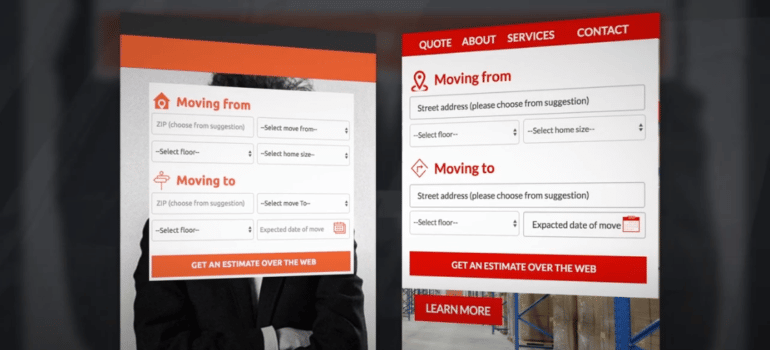
Most online moving quote calculators follow the same sequence:
- Enter the origin address or ZIP code.
- Enter the destination and the expected move date.
- Pick the home size or select the items to move.
- Add access details such as floor, stairs, elevator, and truck access.
- Choose extras like packing, specialty items, or storage.
- Leave a name, email, and phone number, then see the estimate.
The order changes from form to form, and advanced versions add route selection or a video survey. What matters is that every field maps to a line in the mover’s price sheet. A field the math never uses adds friction without improving the quote. Field choice, labels, and order are covered step by step in our walkthrough on how to create the perfect moving estimate form.
Instant quote, lead form, or estimate app: which one should movers use?
“Online moving quote” covers three different tools. They collect similar inputs but give the customer, and the mover, very different things. The table compares them with the in-home or virtual survey that most long-distance jobs still end with.
| Form type | What the customer gets | What the mover gets | When to use it |
|---|---|---|---|
| Instant quote calculator | A price estimate on screen in seconds, based on the mover’s own rates | Contact details plus move date, distance, home size, and extras, captured before the price is shown | Local and standard residential moves with predictable pricing; high-traffic pages and paid campaigns |
| Lead form (request a quote) | A promise of a callback or an emailed quote, with no price on the page | Contact details and basic move info; the sales team builds the quote by hand | Commercial or unusual moves, or companies not ready to put pricing logic online |
| Moving estimate app (photos or video) | A closer number after uploading photos or a video walk-through of the home | A visual inventory for a more accurate quote and clear upsell options such as packing | Long-distance and high-value moves where volume is hard to self-report |
| In-home or virtual survey | A firmer written estimate after a full walk-through | The most accurate inventory, at the cost of scheduling time | Final pricing for interstate, international, and large commercial jobs |
Instant quote calculators
An instant quote calculator answers the first question every shopper has: how much will my move cost? Because the price appears without a callback, it fits customers who compare movers at night or on weekends. The trade-off is setup work, since the mover’s pricing has to become rules the form can apply. Movers Development’s calculator is custom-coded around each company’s formula rather than installed as a generic plugin, which is what lets it price weight, stairs, packing, and distance the way the mover actually does.
Lead forms
A classic lead form collects the same details but leaves the number to a salesperson. It suits commercial relocations, where office size, IT equipment, and after-hours work make a self-serve price risky. Its weakness is speed: the customer has nothing until someone calls back, and that delay is where many quote requests go cold.
Moving estimate apps
Estimate apps and video surveys let customers upload photos or record a walk-through instead of guessing how many boxes they own. A well-designed moving estimate app gives a more accurate number than a sight-unseen online quote, and the uploaded inventory shows the sales team where to suggest extra services. The same logic sits behind online moving estimates versus in-home surveys: the more the mover sees, the firmer the price can be.

Which pricing variables should your quote form include?
A quote is only as accurate as the inputs behind it. The Movers Development calculator is built to price on distance, volume, flights, weight, packing, or any other variable a mover charges for, so treat the list below as a starting point, not a limit. If you run one of the newly established moving companies and are still settling your rates, finish the price sheet first. A calculator only automates pricing you already trust.
Distance and route
Every mile changes fuel, drive time, and crew hours, which is why online moving quote calculator forms open with From and To fields. Many movers price local jobs by the hour and long-distance jobs by weight or volume and mileage, so the form should branch as soon as it knows the distance. Moving someone down the block and moving them coast to coast should never run through the same formula.
Move type and volume
A one-bedroom apartment, a family house, and a warehouse are three different jobs with different crews and trucks. An items section or a home-size dropdown lets the calculator estimate volume. A separate commercial path keeps office moves from being priced like residential ones, which matters for shoppers searching for a commercial moving calculator.

Flights of stairs and access
Carrying a piano or a king-size bed down four flights takes far longer than a ground-floor load. Floors, stairs, elevator access, doorway clearance, and how close the truck can park should all be fields, both at pickup and at delivery. These are also the details customers forget on the phone, so asking for them up front prevents disputes on moving day.
Packing and specialty items
Packing takes training, especially for pianos, artwork, electronics, pool tables, antique furniture, and fine china. Boxes, tape, wrap, and crates cost money too, so they should be priced either as line items or inside full-service packages. A toggle for each of these additional moving services lets the customer build the quote and shows them what each option adds.
Season, timing, and storage
Most people move between May and September, and peak-season demand is one of the clearest trends in the moving industry. Build seasonal rates into the formula instead of adjusting them later by phone. Storage needs often show up late in planning, so a simple storage question with an expected duration keeps that revenue in the original quote.

Why does lead response time decide who books the move?
Moving customers usually request several quotes and lean toward whoever answers first with a credible number. When a quote request sits in an inbox until the next morning, the prospect has often already spoken with a competitor. Reducing lead response time is a sales problem, not only a customer service one.
An instant calculator cuts the wait for the price itself to zero. The customer sees an estimate on screen, and the mover gets a lead that already includes distance, volume, and the move date, so the first call can start with booking instead of questions. On the Movers Development calculator, contact details are captured before the final amount appears, which secures the lead whether the customer books now or later. Offering that to every visitor turns more of the traffic you already have into moving leads.
Is a quote calculator a type of moving leads software?
Partly. It generates and pre-qualifies leads, but it does not replace a CRM. The setup that works is a calculator that pushes every quote into the sales pipeline automatically. Movers Development integrates the calculator with any CRM or payment solution that has API documentation and accepts website requests, so calculator leads land in the same place as phone and email inquiries. If you are still choosing that system, compare the options in our review of the best CRM software for movers.
How does the calculator help the sales team?
Sales reps stop typing quotes for price shoppers and spend their time on people who have already seen a number and stayed. Since customers see an estimate before they speak to anyone, the calls that come in are pre-qualified. Fewer in-home visits for small local jobs also mean fewer consultant hours spent on leads that were never going to book.

How can a quote calculator grow your moving business?
A common objection is that the sales team should handle all pricing questions. The problem is that many shoppers drop off at the last step, contacting the company, because they are unsure what price they will hear. Locking every price behind a phone call can look evasive and makes customers assume the rates are high. A calculator removes that doubt and puts the decision in the customer’s hands.
Show the breakdown, not just a total
A quote that lists transport, labor, packing, and storage as separate lines looks more transparent than a single figure. Customers who see what each extra costs are more likely to add it, and a clear breakdown makes the final invoice easier to accept. Say plainly that details can still be adjusted for jobs like furniture disassembly, so the form never feels like a fixed menu.
Reuse the calculator in email and exit pop-ups
A free moving estimate is a strong reason to subscribe, so offer the detailed quote in exchange for an email address and follow up with seasonal offers. A simplified version of the calculator also fits inside an exit pop-up, the window that appears when a visitor moves to close the tab. It has fewer options than the full page, but it gives an undecided visitor one more reason to stay.
Make transparent pricing part of your brand
Promote the calculator as a service in its own right: a price in minutes and no surprise charges on moving day. That message supports brand development for moving companies because it gives you one concrete difference to talk about in ads, on social media, and in reviews. Customers who got an honest number the first time are also the ones who refer friends and help you win more repeat business.

How should moving companies advertise online quote services?
A calculator nobody finds does not generate leads. The audience most likely to use it is working professionals and families who plan their move outside business hours, so the message is speed and control: a price in a few clicks, at any time of day. These channels carry that message best:
- Search: build pages around queries like “movers online quotes” and “moving company instant quote,” and keep local listings accurate; SEO for moving companies puts the form in front of nearby customers.
- Paid search: bid on high-intent quote keywords in Google Ads and Microsoft Ads and use sitelinks that open the calculator directly; PPC for moving companies works best when the ad and the landing page promise the same instant quote.
- Reviews: ask customers to mention how easy and accurate the online moving quote was, because those reviews build trust in the number.
- Social media and email: post short clips of the quote flow and re-engage visitors who started a quote but did not finish it.
- Analytics: track how many visitors open the calculator, how many complete it, and how many book, so budget follows the channel that produces jobs.
Placement matters as much as promotion. Put a clear quote CTA on every service page, not only the homepage, and make sure the form loads fast on phones. Google’s Core Web Vitals documentation explains the loading, interactivity, and visual stability metrics it uses to assess page experience.
The search side of this is covered in depth in our article on the SEO benefits of featuring an instant quote calculator on your moving website. For channels beyond the calculator, use our list of ways to advertise your moving company.
Why do customers abandon moving quote forms?
The usual causes are too many fields on the first screen, unclear buttons, and forms that break or load slowly on mobile. Ask for the move basics first and contact details last, keep dropdowns short, and test the form on an older phone before launch. A calculator that looks bolted onto the page also loses trust, which is why website design for moving companies and the quote form should be planned together. Our breakdown of whether your moving quote form is confusing customers lists the specific warning signs.

How do you add an instant quote calculator to your website?
For Movers Development clients, the setup follows four steps:
- Schedule a demo.
- Define the calculation and the layout.
- Get the calculator installed on your website.
- Use the new leads to maximize sales efficiency.
The calculator is custom-coded for each company’s pricing, and installation includes design and code changes so it matches the existing site and brand. It is sold as a one-time installation with no monthly subscription; the price depends on the level of customization and how complex the calculation is. The default form flow has three steps (move information, pricing options, contact details), and it can be changed on request. The full feature list is on the instant moving quote calculator page, and related tools are covered in our movers software articles.
Ready to turn online moving quotes into booked jobs?
A well-built online moving cost calculator gives customers a price when they want it and gives your sales team a qualified lead before the shopper moves on. Movers Development designs, codes, and integrates quote calculators for moving companies across the US, Canada, and other countries, and connects them to the SEO and PPC campaigns that bring the traffic. Request a free marketing analysis to see where your quote form is losing leads, and we will show you what a moving cost calculator built on your own pricing would look like.
Frequently Asked Questions
What is a moving costs calculator?
A moving costs calculator is an online form on a moving company website that estimates the price of a move from details the customer enters: origin and destination, move date, home size or item list, floors and stairs, and extras such as packing or storage. It applies the mover's own rates, shows an estimate on screen, and sends the customer's contact details to the company as a lead.
Are online moving estimates accurate?
Online moving estimates are as accurate as the inputs and pricing rules behind them. A calculator that uses the mover's real formula for distance, volume, weight, stairs, and packing gives a realistic ballpark for standard moves. For long-distance or high-value moves, photo or video estimates and in-home or virtual surveys give a firmer number, because the mover sees the actual inventory instead of relying on the customer's description.
What is the difference between an online moving quote calculator and a quote request form?
An online moving quote calculator shows the customer a price estimate on screen within seconds, based on the mover's own rates. A quote request form only collects contact and move details, and the customer waits for a salesperson to call or email a price. Calculators suit standard residential moves with predictable pricing; request forms suit commercial or unusual jobs that need manual pricing.
Can a moving calculator handle commercial moves?
Yes, if it has a separate commercial path. A commercial moving calculator needs different inputs than a residential one, such as office size, number of workstations, IT equipment, and after-hours or weekend scheduling. Many movers use the calculator to capture the lead and a ballpark figure for small offices, then confirm larger commercial jobs with a walk-through before giving a final price.
How does an online moving calculator reduce lead response time?
An online moving calculator removes the wait for the price itself. The customer sees an estimate immediately instead of waiting for a callback, and the mover receives a lead that already includes distance, volume, and move date. The sales team can then open the first call with booking details instead of basic questions, which shortens the time from inquiry to booked job.
Is a moving quote calculator the same as moving leads software?
Not exactly. A moving quote calculator generates and pre-qualifies leads on your own website, while moving leads software usually means CRM or lead management tools that track and follow up on those leads. The two work best together: the calculator sends each quote and contact record into the CRM through an API integration, so calculator leads sit in the same pipeline as phone and email inquiries.
How should movers advertise online quote services?
Movers should promote online quotes where shoppers already compare companies: search results, paid search ads, review profiles, social media, and email. Build landing pages around queries like movers online quotes, send PPC ads straight to the calculator, ask customers to mention the quote experience in reviews, and track how many visitors open, complete, and book through the calculator so budget follows the channels that produce jobs.
What is a moving estimate app?
A moving estimate app lets customers get a moving quote from a phone by entering move details and uploading photos or a video of their home and belongings. Because the mover can see the actual inventory, the estimate is usually more accurate than a sight-unseen online quote, and the sales team can spot extra services such as packing or crating to offer before the move.


