



A moving company CRM keeps every lead, estimate, booked job, crew assignment, and customer message in one system, so nothing gets lost between the first call and the final invoice. For movers, the right platform also has to handle dispatch, claims, storage billing, and mobile crew tools, which most generic sales software was never built to do.
This guide from Movers Development, a digital marketing agency that works only with moving companies, compares the five strongest moving CRMs heading into 2026, recaps what each one changed during 2025, and explains where lead management, lead tracking, and engagement software fit next to your CRM.
Which moving company CRM is best in 2026?
We rated each platform on three criteria. Features means tools built for moving work: dispatching, claims handling, lead automation, and digital documents. Cost covers entry-level pricing and long-term value as you add trucks, crews, or locations. User-friendliness matters because a CRM only pays off if your office staff and crews use it every day. All five platforms below were top contenders in our original analysis, and each shipped meaningful updates during 2025.
| CRM | Best for | Standout features | Pricing (as of 2025) |
|---|---|---|---|
| MoversTech | Movers that want simple workflows now and multi-branch support later, without switching systems | Configurable workflows and custom fields, flexible extra charges and storage billing, unified SMS and email inbox, ACH payments | Predictable and transparent; no long-term contracts or forced upgrades |
| Elromco | Companies that want a feature-rich, all-in-one system | Lead management, estimating, online booking, dispatch, bills of lading, integrated payments, customer portals, AI tools | Per-user Starter, Professional, and Enterprise tiers (replaced a flat rate from $259/month billed yearly) |
| Supermove | Teams that live in texting and email and want sales automation | Real-time texting and email, message templates, Automated Booking, AI Sales Copilot with follow-ups and call summaries | Not published; contact the vendor |
| SmartMoving | Larger operations with complex pricing rules and high job volume | Online booking with real-time availability, crew scheduling through payroll, BI reporting, open API, payments via Remedy Payments | Essential $299/month, Growth $399/month |
| Movegistics | Mobile-first teams and higher-volume operations | Crew and survey mobile tools, self-service customer portal, invoicing, automated task reminders and lead follow-ups | Higher entry point than in previous years |
The short version: owner-operated movers usually get the most from straightforward workflows, transparent pricing, and quick onboarding. Multi-location companies should give more weight to advanced automation, complex pricing rules, role-based access, and detailed reporting.
What is a CRM for movers, and how is it different from lead software?
Customer Relationship Management (CRM) software is a client-oriented system that helps you retain existing customers, find new ones, and win back past ones. It collects everything about each customer in one central database, so whoever picks up the phone sees the same history, preferences, and open issues. A moving company CRM goes further and connects that record to estimates, jobs, crews, and billing.
The software you will see in this space falls into four related categories:
- Lead management software captures, assigns, and nurtures leads through your sales funnel.
- Lead tracking software records where each lead came from and what stage it has reached.
- Lead engagement software automates personalized follow-ups so prospects reply to you, not a competitor.
- Customer engagement platforms connect email, SMS, chat, and other channels into one omnichannel workflow.
A good CRM for moving companies covers most of the first three on its own. In our work with 400+ moving companies, the question owners ask most is which channel produced a booked job, and that answer only exists if the CRM stores a lead source for every inquiry, whether it came from PPC campaigns for moving companies, organic search, or a referral.
What features should the best CRM for moving companies have?
The core features of moving company software have stayed familiar, but 2025 updates turned smarter automation, better mobile access, and wider visibility across operations into standard expectations. Look for:
- Lead management and tracking: capture leads, assign them to team members, track progress through the funnel, and automate nurturing.
- Customer communication tools: personalized email and SMS sent from inside the platform, which is central to generating leads for a moving company and keeping customers.
- Streamlined dispatching: jobs assigned to crews and trucks without spreadsheets or phone chains.
- Claim management: documentation, resolution tracking, and customer communication for damage claims in one record.
- Real-time reporting: customizable dashboards so you can adjust pricing, staffing, or marketing while it still matters.
- Documents and e-signatures: estimates, contracts, and bills of lading sent, signed, and stored in the system.
- Estimates and price calculation: a built-in price calculator speeds up onboarding, since the quote is often the first real conversation with a customer.
- Mobile access: crews and sales reps update jobs and contact customers away from the desk.
The 5 best CRM software options for moving companies
Each moving company CRM below has a distinct strength, so the right pick depends on your company size, operational complexity, and how your team prefers to work. Disclosure: MoversTech was customized with input from the Movers Development team, so we know it well; we hold it to the same three criteria as the rest.
1. MoversTech
Built specifically for the moving industry by people who know how complex the business is, MoversTech CRM for moving companies pairs a clean interface with configurability usually found in enterprise systems. You can start with simple workflows and grow into multi-branch operations without migrating to another CRM later. Pricing stays predictable, with no long-term contracts or forced upgrades.
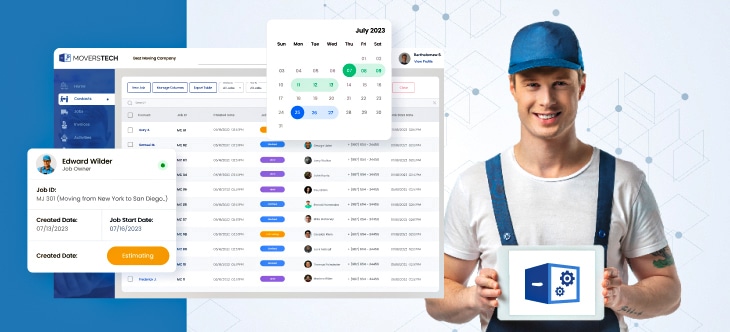
In 2025, MoversTech expanded billing to match real moves: more flexible extra charges, adjustable storage billing dates, and consistent labor rounding. Custom fields now flow through contracts, emails, and integrations. Daily operations views, flexible arrival windows, and a unified SMS and email inbox tie every message to the correct job. Payments gained automatic receipts, clearer invoice histories, and wider ACH support, while storage handling now covers warehouses, zones, and containers for short- and long-term storage.
2. Elromco
Elromco is cloud-based moving software that suits both small teams and established companies that want everything in one place. Core functionality covers lead management, estimating, online booking, dispatching, billing, and customer communication. Quote generation, bills of lading, and integrated payment processing keep each job organized from first inquiry to move completion.
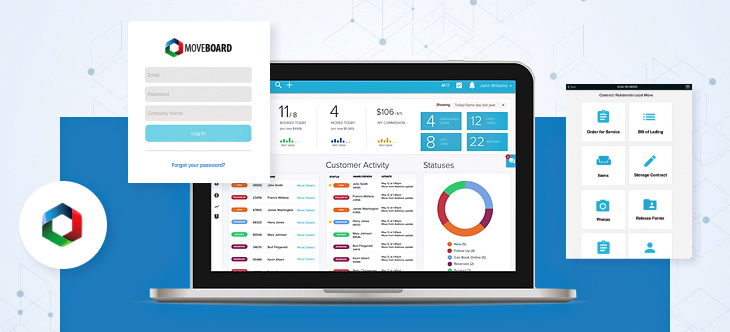
The biggest 2025 change was pricing. Elromco moved from a flat rate, which started at $259 per month billed yearly, to a user-based model with Starter, Professional, and Enterprise tiers that scale with team size. Combined with ongoing work on AI tools, dispatching, storage, and customer portals, it fits movers that want a full feature set and accept a higher monthly investment.
3. Supermove
Supermove is built around communication, inside your team and with customers. Real-time texting and email keep everyone updated, interactions are recorded for later review, and customizable templates keep your tone consistent. It also covers lead capture, dispatch, document management, and live reporting on business metrics.
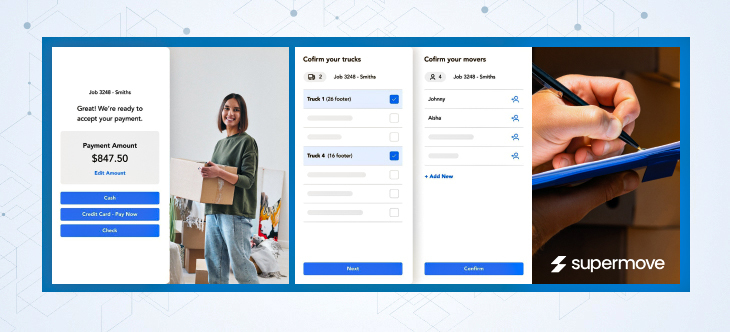
During 2025, Supermove added Automated Booking and the AI Sales Copilot, which handle automated follow-ups, call summaries, and workflow assistance so reps respond to leads faster. It is a strong option for movers preparing for higher job volume. The trade-off is transparency: Supermove does not publish pricing, so you need to contact the company for a quote.
4. SmartMoving
SmartMoving focuses on booking and dispatch. Customers can schedule with real-time availability and pricing, while dispatchers assign crews and resources from one board. Crew management covers scheduling, job assignments, and performance tracking, and the platform connects every step from booking to payroll.
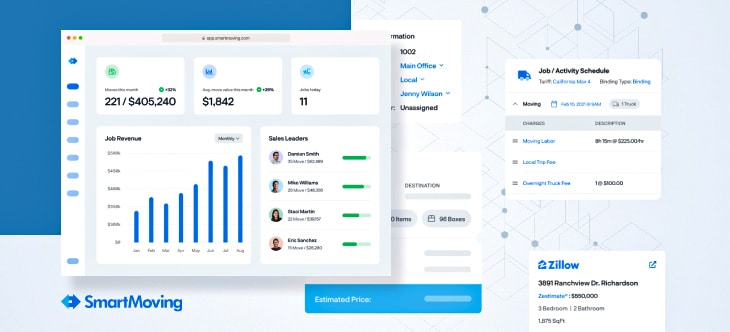
SmartMoving started listing prices in 2025: the Essential plan at $299/month and the Growth plan at $399/month. It also added automation tools, deeper business intelligence reporting, and broader API integrations, and late in the year it announced the acquisition of Remedy Payments to strengthen integrated payment processing. It suits enterprise-ready operations with complex pricing rules.
5. Movegistics
Movegistics by Netensity is the mobile-first pick. Field teams access and update job information in real time, and a self-service customer portal lets clients track progress and manage parts of their move. An invoicing system that integrates with key financial tools speeds up billing.
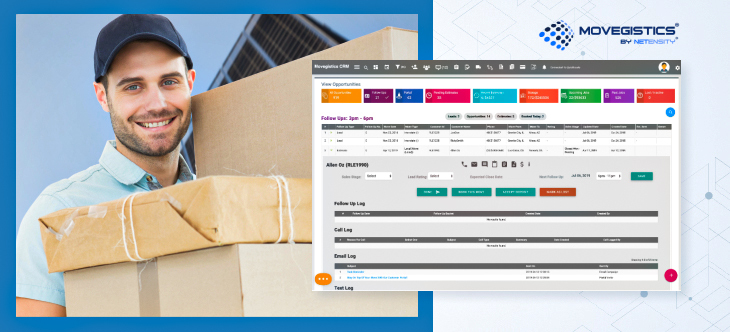
In 2025, Movegistics added automated task reminders, lead follow-ups, and cleaner handoffs between sales, dispatch, and crews, and refined its crew and survey tools for faster, more accurate field data. Plans now start at a higher entry point than in previous years, so it is no longer the budget option, but it remains solid for higher-volume operations that value mobility and customer portals.
When does generic lead management software make sense?
A lead is any party that could become a client down the line. The problem starts when one person has more leads than they can follow, because a lead neglected even briefly can mean a lost customer. Lead management software exists to convert and manage that pipeline. Six general-purpose options come up most often:
- Salesforce Sales Cloud: deep customization for experienced users, with a steep learning curve for beginners.
- Zoho CRM: a long-standing, well-regarded option, though workflow automation requires the higher Professional edition.
- Creatio CRM: excellent analytics, but building forms takes some coding experience.
- Less Annoying CRM: the easiest to learn and more affordable, with fewer advanced features.
- Copper: fully integrated with Google Workspace (formerly G Suite), including Gmail and Google Calendar.
- Bitrix24 CRM: a balanced package with customizable automation, held back by a clunky interface.
These tools work for the sales side, but none was designed around estimates, crews, or bills of lading. If moving-specific alternatives exist for your size and budget, a niche CRM usually saves you from stitching three systems together.
What is the best lead tracking software for movers?
Lead tracking software for moving companies should show, for every inquiry, the contact information, how the person reached your website, what they researched, and how they move on your dashboard from lead to customer. That view tells your reps how to approach each prospect and tells you which channels deserve more budget.
Among general platforms, Salesforce is cloud-based and tracks contact history and task scheduling for each lead, which suits remote sales teams. Zoho offers a free plan for testing, while its paid Standard package adds customized dashboards and sales forecasting. QuickBase, originally an Intuit product, lets you set custom notifications, reminders, and alerts, and it adds a mobile app and payment processing.
Moving-specific CRMs such as MoversTech combine pipeline tracking with financial processing and a price calculator, which matters because the estimate is a big part of client onboarding. If you also run an instant moving quote calculator on your website, make sure its submissions land in the CRM with the source attached. Owners searching for MoverBase or MoversSuite alternatives can use the comparison table above the same way: shortlist by pricing model, dispatch depth, and mobile crew tools.
How does lead engagement software help movers book more jobs?
Lead engagement closes the gap between you and prospects who are being targeted by every mover in your market. The most common mistake is investing in lead generation and then failing to follow up or retain those customers. Four habits fix most of it:
- Keep your stack simple. Limit the number of applications and scale a few proven tools instead of switching providers often.
- Stay customer-centric. Build buyer personas for your main customer types and share them with sales and marketing.
- Keep marketing after the move. Past customers are your best ambassadors when friends ask for a mover.
- Ask for feedback. Customers compare you with competitors instantly, so ask whether your follow-ups are useful.
Dedicated lead engagement software adds outreach automation on top of your CRM. Klenty sends personalized sales emails, books meetings, and automates follow-ups, and it connects to SMTP, Office 365, and Gmail. Lemlist automates follow-ups across several channels with custom intro lines and landing pages. Postaga is an AI-assisted outreach platform that leans toward link building and partnership outreach. Pair any of them with a clear plan for closing more moving leads, or the extra replies will not turn into booked jobs.
What is a customer engagement platform?
A customer engagement platform is a suite of tools that tracks, manages, and automates communication with leads and customers across email, SMS, chatbots, and other channels. Think of it as a nerve center: engagement, or the lack of it, in one channel triggers an action in another. A customer who ignores a quote email can get a follow-up SMS automatically, all without leaving the platform.

Many engagement platforms grew out of CRMs, which are now cloud-based, analytics-driven, and connected to other software. Customer data platforms (CDPs) collect data from many sources into profiles and pass it to marketing, sales, and support tools. Customer experience management (CXM) systems have a narrower job: analyzing feedback to improve the experience. When choosing one, look for:
- recognition of one customer across channels, merged into a single profile
- segmentation by shared traits for targeted campaigns
- channel attribution that links outcomes to touchpoints, such as a visit from an Instagram ad
The payoff is measurable. Gallup research on customer centricity found that fully engaged customers deliver a 23% premium in share of wallet, profitability, revenue, and relationship growth.
What are the benefits of CRM software for moving companies?
A moving customer does not need your services often, which makes every relationship worth tracking carefully. The main benefits of CRM software for movers are:
- Organized information: sticky notes and filing cabinets are replaced by one cloud database every department can access.
- Consistent communication: if a customer’s usual contact is out, anyone can pick up with full context.
- Faster customer service: past jobs, preferences, and complaints appear the moment a customer calls.
- Automated paperwork: forms, reports, and reminders run in the background, so reps focus on closing.
- Better teamwork: sales, marketing, and customer service share one record and move clients down the pipeline together.
- Accurate reporting: personalized dashboards show sales figures, performance, and goals in one view.
- Clearer customer insight: purchase history, service calls, and past complaints help you prevent issues before they occur.
- Stronger retention: texts, emails, online forms, and social messages from one place keep past customers loyal and referring.
How does a moving CRM support your marketing?
The same data that runs your operations also powers smarter marketing. With the right CRM software for movers, you can segment customers by move history, preferences, or feedback, then send targeted campaigns that feel personal from first contact to post-move follow-up. Email automation is where most movers see results first, and our guide on improving your email marketing strategy shows what to send and when.
Many CRMs now connect with Google Ads, Facebook, Mailchimp, and review tools, so you can run and track campaigns without switching systems. Tie those numbers to booked jobs and you can measure and optimize digital ROI with real revenue instead of form fills.
How do you choose and switch to a new moving CRM?
- Map your workflow from first inquiry to final invoice, including storage and claims.
- Shortlist by size: simple workflows and fast onboarding for small teams; role-based access and complex pricing rules for multi-location movers.
- Compare pricing models: per-user tiers, flat plans like SmartMoving’s $299 and $399 options, or quote-only pricing.
- Test the CRM for moving company tasks you run daily, such as an estimate, a dispatch change, and a payment, during the demo.
- Time the switch for a slower season or right after major platform updates, when you are reviewing features anyway.
Your moving company CRM is one piece of a wider stack, so check how it connects with the rest of the technology modern moving companies rely on, from accounting to your website forms.
Turn your CRM data into booked moves
The best software only pays off when qualified leads keep flowing into it and every booked job can be traced back to its source. Movers Development builds SEO, PPC, and website strategies exclusively for moving companies, and we help 400+ movers across the U.S., Canada, and other countries connect marketing results to their pipeline. Request a free marketing analysis and we will show you how many more leads your moving company CRM could be handling.
Frequently Asked Questions
What should movers prioritize when choosing a CRM?
Moving companies should prioritize ease of use, dispatch and crew management, automation, mobile access, and reporting. The CRM also needs to fit your size and workflow: an owner-operated mover needs fast onboarding and transparent pricing, while a multi-location company needs role-based access and complex pricing rules. Moving-specific platforms such as MoversTech, Elromco, Supermove, SmartMoving, and Movegistics cover estimates, crews, and bills of lading that generic sales CRMs do not.
Which CRM is best for small moving companies?
For small or owner-operated moving companies, the best CRM has straightforward workflows, transparent pricing, and quick onboarding. MoversTech offers predictable pricing with no long-term contracts and lets you add complexity only when you grow, and SmartMoving lists its Essential plan at $299 per month. If you only need basic lead management, Less Annoying CRM is the easiest general-purpose option to learn, though it lacks moving-specific dispatch tools.
Which CRM is best for larger moving companies?
Larger and multi-location moving companies benefit most from a CRM with advanced automation, complex pricing rules, role-based access, and detailed reporting. SmartMoving suits enterprise-ready operations, with a Growth plan at $399 per month, BI reporting, and API integrations. Elromco offers per-user Starter, Professional, and Enterprise tiers, and Movegistics fits high-volume teams that rely on mobile crew tools and customer portals.
When is the right time to upgrade or switch a moving CRM?
The best time to evaluate or switch a moving CRM is during a slower season or right after major platform updates, when you are already reviewing features and pricing. Several leading platforms changed pricing in 2025, including Elromco's move to per-user tiers and SmartMoving's published $299 and $399 plans, so it is worth checking whether your current system still matches your operations and costs.
What software solutions are recommended for managing and tracking leads effectively?
For moving companies, a moving-specific CRM such as MoversTech, SmartMoving, or Elromco is usually the most effective way to manage and track leads, because it links each lead to estimates, jobs, and billing. General-purpose options include Salesforce Sales Cloud for deep customization, Zoho CRM, Creatio for analytics, Copper for Google Workspace users, Bitrix24, and QuickBase for custom alerts and mobile access.
Does a moving company CRM include email automation?
Yes, most moving company CRMs include email automation alongside SMS. MoversTech has a unified SMS and email inbox tied to each job, Supermove's AI Sales Copilot automates follow-ups, and Movegistics automates lead follow-ups and task reminders. Many CRMs also connect with Mailchimp, Google Ads, and Facebook, so you can segment customers and track campaigns without leaving the platform.
What is lead engagement software?
Lead engagement software automates personalized outreach so prospects respond to your company instead of a competitor. It sends tailored emails, books meetings, and runs automated follow-ups across channels. Examples include Klenty, which connects to Gmail, Office 365, and SMTP, and Lemlist, which handles multichannel follow-ups. For movers, it works best on top of a CRM that already stores every lead and its source.
What is a customer engagement platform?
A customer engagement platform is a suite of tools that tracks, manages, and automates communication with leads and customers across email, SMS, chatbots, and other channels. It merges each customer's activity into one profile, segments customers for targeted campaigns, and links outcomes to touchpoints. Many modern CRMs and customer data platforms now cover these functions, which is why movers often get engagement features inside their CRM.


