


Your domain name is the address of your moving company’s website, and it is the one piece of your online presence that is costly to change later. Choosing a domain name for your business comes down to a few decisions: brand or keyword, .com or another ending, city or no city, and who holds the registration. Movers Development works only with moving companies (400+ clients in the US, Canada, and other countries), and the points below are the ones worth settling before you build anything.
| Decision | Recommendation | Why | Common mistake |
|---|---|---|---|
| Brand vs. keyword | Brand-first name; add a mover cue only if it reads naturally | A brand is memorable and ownable. A keyword string is generic and easy to copy. | Cramming “moving” and a neighborhood into one long string |
| .com vs. other TLDs | .com by default; .ca for Canadian movers if the .com is taken | Customers type .com from habit, and an unfamiliar ending is easy to mistype. | Accepting an odd ending just to keep the exact name |
| City in the domain | Only if the brand name itself includes it | A city in the domain boxes you into one market. Location pages can grow with you. | Naming the domain after one neighborhood, then expanding the service area |
| Hyphens and numbers | Avoid both | They are hard to say over the phone and are easy to mistype or mistake for spam. | Registering a hyphenated copy of a name someone else holds |
| Buying an existing domain | Only after a history, trademark and ownership check, through escrow | You inherit the domain’s past content and links along with its name. | Paying first and checking the archive afterward |
| Protecting variants | Register your likely misspelling and redirect it to the main domain | Typos then reach you instead of a competitor. | Buying dozens of variants nobody will ever type |
What makes a good domain name for a moving company?
A good domain passes a phone test. A customer calls your office, a friend recommends you, a crew lead reads the address off a truck: every one of those moments needs a name people can say once and type correctly. That rules out most clever spellings.

Run every candidate through this short list before you fall in love with it:
- Say it out loud to someone who has never seen it, then ask them to type it.
- Keep it short enough to fit on a truck door and a business card.
- Use standard spellings unless a misspelling is your actual brand name.
- Make sure it still fits if you add services, such as storage or long-distance moves.
If ideas dry up, a domain name generator can help you brainstorm. Treat its suggestions as raw material, and confirm availability at a registrar before you get attached. The naming itself belongs to your brand, so start with choosing a name for your moving business and let the domain follow it.
Should your domain be a brand name or a keyword?
Brand first. Keywords in a domain tell people what you do, but a domain is not what makes a moving site rank: your pages, your reviews and your Google Business Profile do that work, and we treat a keyword in the domain as a minor signal at most. Exact-match strings such as “cheapmovingnyc” also read as generic, and you cannot trademark or defend them as easily as a distinctive name.
A middle path works for many movers: a distinctive brand word plus one plain cue, such as a hypothetical bridgemovers.com. It says what the company is without stuffing keywords. If you do want a keyword in the name, keep it to one word and keep the rest pronounceable.

Which TLD should you use?
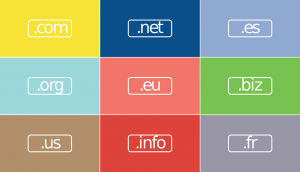
The top-level domain (TLD) is the ending of your address: .com, .net, .org, .ca and so on. For a US mover, .com is the safest default, because it is what customers type when they guess. If the .com is taken, .net or .us are workable second choices. Canadian movers can use .ca, which is the familiar ending for Canadian customers.
What to avoid is a strange ending adopted only to keep an exact name. Customers who guess .com will land on someone else’s site, and you pay for that confusion in lost calls.
Should the domain include your city?
Only when the city is already part of your brand. A domain locked to one neighborhood becomes a problem the day you add a second service area or start taking long-distance jobs, and a string like movingharlempeople.com looks stuffed to customers and search engines alike. Put cities on their own pages instead. Our guide to SEO for moving companies covers how location pages are built so each market gets its own page without changing your domain.
Why avoid hyphens and numbers?
Both break the phone test: “is that the number 4 or the word for?” and “where does the hyphen go?” are questions your customers should never have to ask. Hyphens are also common on copycat and spam domains that imitate real brands, so a hyphenated name can look suspicious next to the name it imitates. If your first choice is taken, change the name rather than patching it with a hyphen.
How do you check a domain name before you buy it?
Availability is only the first check. A name can be free to register and still cause trouble through a trademark, a social handle you cannot match, or a past life as a spam site. Do these checks before you pay, because a registered domain is hard to walk away from once your logo and trucks carry it.
Check the trademark and social media handles
Search the name in the USPTO trademark database and look for similar names in moving and related services. A domain that sits close to an existing mark can invite a dispute or simply confuse customers. In Canada, run the same check against the national trademarks database. Then confirm you can get the same handle on Facebook, Instagram, YouTube and your Google Business Profile name. A matching name everywhere is part of the brand.
Check the domain’s history for spam and penalties
A domain that has been registered before carries its past with it. Before buying one that is not brand new, run through this sequence:
- Search the domain with the site: operator in Google and see whether any pages are indexed.
- Look through the Internet Archive’s Wayback Machine for earlier content, such as gambling, pharmaceutical or adult pages.
- Check the domain’s backlinks in a link tool for unnatural or foreign-language links.
- Search the name for complaints, scam reports or a bad-reputation business that used it.
A clean history is no guarantee, and a problem can surface only after you verify the domain in Search Console. That is why we advise against buying an old domain just for its age. You are buying the history along with the name, so price it accordingly.
What if the name is already registered?
Look up who holds it. If the site is active, pick another name. If it is parked or for sale, confirm the seller actually controls it, pay through an escrow service rather than direct to a stranger, and have the transfer completed before your launch date. If the domain is a real asset to you, our piece on increasing the value of your domain name covers what makes one worth more over time.
Who should own your domain name and DNS?
You should, in your own company’s name. The registrant is the legal owner, and the registrar account is where renewals, transfers and DNS records are controlled. Register through an account that uses a company email address you control, with two-factor authentication turned on and auto-renew enabled. You can check the registrant data for any domain at the ICANN registration lookup, and some registrars mask it with privacy settings, which is fine as long as the account itself is yours.
Why shouldn’t an agency hold your registration?
The mistake we most want you to avoid is letting a web developer, freelancer or agency register the domain in their account “for convenience.” If the relationship ends badly, you cannot renew, move or repoint your own address. Ask any provider to put the registration in your name and give you the registrar login. The same principle applies to hosting, analytics and ad accounts, which we cover in our guide to avoiding deceptive agency practices.
How should you handle DNS and registrar security?
DNS records deserve the same attention. They point your domain to your website, and also route your email, so a bad edit can take both offline at once. Keep a written list of your current records before anyone changes them, and make your registrar account part of your website security basics: a registrar lock to block unauthorized transfers, strong unique passwords and a renewal reminder that goes to more than one person.
When a design partner builds your site, the domain should simply be pointed at the new hosting. It should never move into the partner’s account. That is how we handle it on website design for moving companies.
Should you register extra domain variants?
Register the obvious misspelling of your name, and the .net or .ca version if your brand is distinctive enough to attract copycats. Then redirect each to your main domain with a 301. Beyond that, extra domains are a yearly cost with little return, and every additional name is one more renewal to track.
What happens if you change your domain name later?
Sometimes you have no choice, for example after a rebrand, a merger or a bad first pick. A domain change can be done safely, but it is a real site move, and it should be planned like one. Google’s documentation on moving a site with URL changes describes the sequence, and it comes down to these steps:
- Verify the old and new domains in Google Search Console, including every www and non-www variant of the old one.
- Map each old URL to its closest new URL, then set up server-side 301 redirects.
- Use the Change of Address tool in Search Console for the old domain. Google’s help page says it prioritizes the new site for 180 days after you file.
- Submit the new sitemap and update your Business Profile, listings, email signatures and ad accounts.
- Keep the redirects live for as long as possible. Google’s guidance is generally at least a year.
Plan the change together with the rest of your brand work. Our guide on rebranding your moving business shows how to sequence a new name, logo and domain, and our web design team for movers handles the redirect mapping so rankings carry over. Expect some ranking movement while Google processes the move.
Final checks before choosing a domain name for your business
Pick a name you can say once and spell once, confirm no trademark or handle conflict, check any used domain’s history, and register it in your own name with the login in your hands. Everything else is a detail you can fix. A wrong owner, a spammy past or a hyphen-riddled name are the problems that cost real jobs.
If you are about to launch, relaunch or move to a new domain, Movers Development can review your choice before you commit. Request a free marketing analysis or contact us and we will tell you what a domain decision means for your website and your search visibility.
Frequently Asked Questions
How do I choose a good domain name for my business?
Pick a short, brand-first name that people can say once and type correctly, on a .com if you can get it. Avoid hyphens and numbers, check the name against trademarks and social handles, and register it in your own company's name. For a moving company, a distinctive brand word plus one plain cue, such as a hypothetical bridgemovers.com, works well.
How do I check if a website name is available or taken?
Enter the name in any domain registrar's search box to see whether it is free to register. If it is taken, look up the registrant with the ICANN lookup and see whether a live website uses it. Before you buy, also check the name's trademark status and whether the matching social media handles are available.
What are the best practices for choosing a domain name?
Keep it short, easy to pronounce and easy to spell, and build it around your brand rather than a string of keywords. Use a familiar ending, usually .com or .ca for Canadian movers. Skip hyphens and numbers, avoid names close to another company's trademark, and register the domain under your own company account.
How important is domain selection for a business?
It matters for brand recall and trust more than for rankings. Your domain appears on trucks, quotes, email addresses and ads, so a clear one helps customers find you. Changing it later means a full site move with 301 redirects, which Google advises keeping in place for at least a year.
Do I need a domain name generator like Domain Wheel?
No, a generator is optional. It can help you brainstorm when your first choices are taken, but you still need to confirm availability at a registrar and run the trademark, social handle and history checks yourself. A name you can say on the phone is more useful than a clever suggestion from a tool.
Should my moving company's domain name include keywords or my city?
Keywords and city are optional. A brand-first name is easier to remember and defend, and a city in the domain locks you into one market. Add a single plain cue such as moving only if it reads naturally. Put each city you serve on its own location page on your site instead.


