



A content strategy for moving companies is the plan that decides what you publish, who each page is for, and which service page or quote form it sends readers to. Without that plan, content writing for movers turns into random packing tips that bring visits but no booked jobs. In our work with 400+ moving companies across the US, Canada, and other countries, the content strategies successful moving companies use look alike: a few strong cornerstone guides, supporting posts that link to them, and a clear path to the quote. Movers Development put this guide together to show what to write, how to plan it, how long it should be, and how to tell whether it works.
Content Strategy for Moving Companies at a Glance
Start with the job each piece of content has to do. The table maps the content types that work for movers to the search intent behind them, a sample topic, and the page each piece should lead to. Replace [City] with the markets you actually serve.
| Content type | Search intent | Example topic for movers | Where it leads |
|---|---|---|---|
| Service pages | Commercial: ready to compare and hire | Long-distance movers in [City] | Quote form, call button |
| Cost and pricing guides | Decision stage: budgeting | How much does it cost to move a 2-bedroom apartment in [City]? | Instant quote calculator, service page |
| Local guides | Informational with local intent | Moving permits and parking rules in [City] | Local moving service page |
| How-to and packing guides | Informational: planning the move | How to pack fragile dishes and electronics | Packing services page |
| Seasonal and timely posts | Informational, time-bound | How to move safely during winter | Quote form, seasonal offer |
| Customer stories and case studies | Consideration: can I trust them? | A last-minute cross-country move, start to finish | Reviews page, quote form |
| Video | Trust and engagement | Behind the scenes: how our crew packs and loads a truck | Service pages, YouTube, social |
| FAQ and process content | Decision stage: what to expect | What happens on moving day, hour by hour | Quote form, contact page |
| Repurposed social posts | Awareness | Top 5 packing hacks clip cut from a blog post | The original blog post |
Notice the last column. Every piece of content needs a next step, and for a moving company that is almost always a service page, the instant moving quote calculator, or a call. Content that ends nowhere is why so many moving blogs get traffic and no leads.
Why Is a Content Strategy Important for Movers?
Writing posts and hoping for the best costs about the same as writing to a plan, but only the plan compounds. The importance of content strategy shows up in five places:
- Targeting. A plan keeps you writing for people who will hire a mover. A home renovation guide may get clicks, but it rarely books a move.
- SEO. Content and SEO for moving companies work together only when each page targets its own keyword. Random posts end up competing with each other and with your service pages.
- Quality control. A strategy sets standards for grammar, structure, fact checks, and plagiarism checks before anything goes live.
- Topic selection. You stop asking “what should we post this week?” because the plan already lists the next topics.
- Measurable goals. You can set a target, such as quote requests from blog visitors, and check it every month.
Why does this matter more for movers than for most businesses? People move rarely, so most of your audience has no favorite mover. The company that answered their questions during research has the best shot at the quote. A moving company content strategy makes sure you are that company for the routes and services you want to sell.
What Should a Moving Company Publish?
Five content types do most of the work for movers: educational guides, local content, seasonal content, customer stories, and video. They were the core of the original version of this guide and they still hold up, with one change: each one now has to point to a page that sells.

Educational blog posts and guides
In-depth guides such as “How to Prepare for Your Cross-Country Move” and step-by-step tutorials on packing fragile dishes or electronic equipment build trust because they solve a real problem. They also give you room to use the most important keywords for movers naturally, without forcing them into service pages.
If you are still deciding whether a blog is worth the effort, start with why every moving company needs a blog. When you are ready to write, these blog ideas for movers will fill your first month.
Local and seasonal content
Seasons change how people search for movers. Winter moving safety, summer heat, college move-out, and end-of-lease dates all deserve their own posts, published before demand peaks so they have time to rank. Local content works the same way. Neighborhood guides, school districts, and “Moving Permits and Parking Rules in [City]” posts show that you know the area. Local regulations confuse customers, so a clear explainer builds trust and supports your local rankings at the same time.
Customer stories, video, and team content
Case studies of difficult moves, such as a last-minute cross-country job or large furniture on tight city streets, show problem-solving better than any claim. Short videos do the same: behind-the-scenes packing and loading footage, customer testimonial clips, and quick social clips like “Top 5 Packing Hacks.” For more formats, see the most engaging types of content for movers.
Involve your crews and estimators too. They hear customer questions every day, and their answers make better topics than anything a keyword tool suggests. Brand collaboration is another older content marketing trend that still works: a joint post with a local realtor or storage facility, a podcast interview, or a co-written relocation guide reaches an audience you do not have yet. Pick partners in adjacent businesses, never competitors.
Website Content Strategy Guidelines for Your Core Pages
Blog posts get the attention, but your website content strategy starts with the pages that sell. Before you write anything, list what customers need to know: local, long-distance, or international moves; household or office; packing services and materials; storage; and specialty items. Each answer becomes a page or a section, so visitors do not have to call just to learn what you do.
Homepage content strategy
The homepage says who you serve, where, and what to do next. Name the service area and the core services, show proof such as reviews and licensing, and put the quote button where nobody has to scroll for it. Each page should say something different; copy repeated across the homepage, About Us, and service pages tells visitors and Google nothing new.
Service and About Us pages
Service pages carry the commercial keywords, so they need facts instead of promises: what is included, how the estimate works, and which areas you cover. Let reviews and specifics make your case instead of “we do it better than anyone.” The About Us page is where you get personal. Write in first person (“we”), show the crew, and use your own photos instead of stock images. People hire movers they can put a face to.
Formatting that keeps visitors reading
Use descriptive subheadings, bullet lists for services and steps, and images with captions. Link related pages to each other and always give visitors an easy path to your contact page. A moving company website design that loads fast and reads well on a phone makes all of this content easier to use.
How Do You Plan Content? Cornerstone and Supporting Posts
Planning is the step most movers skip. The simplest structure that works is cornerstone content plus supporting posts, built in this order:
- Pick cornerstone topics. Write one in-depth guide per core service or big decision, for example a complete long-distance moving guide or a moving cost guide for your city. Each cornerstone targets one main keyword, and no other page targets it.
- Add supporting posts. Narrower posts answer one question each (packing a piano, moving with pets, storage between closings) and link up to the cornerstone with descriptive anchors.
- Link the cornerstone to money pages. The guide passes readers and link value to the matching service page and the quote form.
- Make it easy to find. Put cornerstone guides in the menu, a “Recommended” block, or category pages, a few clicks from the homepage.
- Promote it. Share it on social media, send it in your email newsletter, and offer it to local partners and industry sites.
- Schedule it. Put supporting posts and cornerstone refreshes on a content calendar for your moving company’s blog, timed ahead of the busy season.

The one-keyword-per-page rule matters more than it looks. When two posts chase the same phrase, Google has to pick one, and often ranks neither well. A plan prevents keyword cannibalization before it starts, which is far cheaper than merging and redirecting posts later.
Does Word Count Matter for SEO?
No. Word count is not a ranking factor. Google’s John Mueller has said so publicly more than once since 2019, and he has added that matching the length of top-ranking pages will not help you rank. Google’s guidance on helpful, people-first content goes further: it asks whether you are writing to a particular word count because you heard Google prefers one, and answers that it does not.
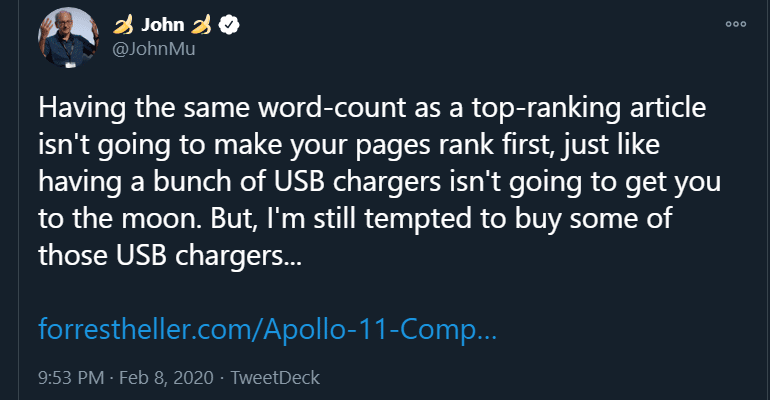
So why do longer posts often rank? Covering a topic fully usually takes more words, and complete pages earn more links and answer more related queries. Length is a side effect, not the cause. If your SEO and content are solid, a 500-word answer can do as well as 1,500 words. A 2,500-word article on a topic you could explain in 500 gives you no edge over competitors. It just makes readers scroll.
How long should a moving company post be?
Let intent set the length. A cost page needs prices, ranges, and what changes them. A cross-country moving guide needs every step from estimate to delivery. A “can movers move plants?” post needs a direct answer and a few specifics. Before you publish, cut every paragraph that repeats a point or says nothing a customer could act on.
How Do You Balance SEO With Quality Content?
The balance is simpler than it sounds: research keywords for every topic, then write for the reader and place keywords only where they fit. When SEO and the reader pull in different directions, the reader wins. Quality website content for movers passes six tests. It is:
- Relevant, answering the question behind the search
- Unique, not copied from your own pages or anyone else’s
- Authentic, with real photos, real crews, and examples from your own jobs
- Engaging, easy to skim, with a strong headline and first paragraph
- Up to date, with prices, rules, and dates checked
- Optimized, with one main keyword, clean headings, and internal links
How to improve content quality
Know your audience and keep checking what they ask through sales calls, reviews, and search data. Give every piece a goal before anyone writes it. Check spelling, grammar, and readability; most SEO tools score readability with the Flesch-Kincaid test. Use images and video only when they add something, structure the page with real heading tags, and end with a clear call to action. Avoid the classic quality killers: keyword stuffing, duplicate content, and several unrelated keywords squeezed into one post.
Write content that AI search can cite
ChatGPT, Perplexity, and Google’s AI Overviews pull answers from pages that state specific, checkable facts and name the company, city, and service. “We serve the area” gives them nothing to quote; a sentence with your company name, the route, and a price range does. The quality rules above apply unchanged, which is why AI search optimization for moving companies builds on the same content work as SEO.
How to Find Content Gaps and Repurpose What Works
Once the plan is running, growth comes from two habits: covering the topics you are missing and getting more out of the posts that already perform.
How to find content gaps
A content gap is a topic your customers search for that your site does not cover. Four ways to find gaps:
- Check Google Search Console. Queries with impressions but no matching page, or pages stuck at positions 11–50, show demand you are only half meeting.
- Run a competitor keyword gap. Tools like Semrush list keywords competing movers rank for and you do not. Use the list for ideas, not as a script, or you will copy their gaps too.
- Ask customers and crews. Estimators and movers hear the same questions every week. Each repeated question is a post or an FAQ answer.
- Audit your own content. List every URL with its main keyword. One pass shows gaps and duplicates, and tells you which old posts to merge or update.
Benefits of repurposing content
Repurposing means taking a piece that works and publishing it again in a new format. The benefits of repurposing content are practical for a busy moving company:
- It saves time and money, because the research is already done.
- It reaches a wider audience, since some people read blogs and others only watch YouTube or scroll Instagram.
- It fits each platform: a long guide becomes a checklist post, a carousel, or a short video.
- It gets more from your best content: find the posts that bring traffic and leads, then republish them in other formats.
- It fixes underperforming posts: update outdated facts, add missing details, or merge thin posts into one stronger page.
A cost guide, for example, can become a seasonal email, a price-range graphic for social media, and a short video answering the most common pricing question. Before you spread content across every network, compare the ways to advertise your moving business and pick the two or three channels your customers actually use.
What Content Strategy Mistakes Do Movers Make?
Most failing moving blogs share the same handful of problems. Check your content against this list:
- Tangential topics. Home-buying strategy guides are related to moving, but they rarely produce a single booking.
- City-swap posts. “Preparing for a Move to [City]” repeated across cities with the same text is thin content. Write a local post only when you have local facts: buildings, parking, permits, routes.
- No plan. Chasing every trend scatters your topics and creates keyword clashes between posts.
- Assumptions instead of data. You may think customers care most about packing; your quote forms and calls may say otherwise. Check before you write.
- Padding for length. Writing to a word count adds scrolling, not rankings.
- No next step. A post without a link to a service page or quote form is a dead end.
- Publish and forget. Prices, regulations, and years in titles go stale. A “content marketing trends 2019” post helps nobody planning a move today.
- Ignoring the technical side. Slow pages and broken mobile layouts lose readers before they read a word.
How Do You Measure Whether Your Content Works?
Judge a content strategy for moving companies by what it does for the business, not by how many posts you published. Track three layers:
- Visibility: impressions, clicks, and average position per query in Google Search Console. Rising impressions with flat clicks point to a weak title or meta description.
- Engagement: in GA4, which posts send visitors on to service pages and the quote form.
- Leads: quote requests, calls, and booked jobs that started on a content page.

Review the numbers monthly and act on them quarterly: update posts that slip, merge posts that compete for the same query, and write the gaps you found. Our guide to the most important marketing KPIs for moving companies shows how to connect content to cost per lead and booked revenue.
Turn Your Content Into Booked Moves

A content strategy for moving companies works when every piece has a job: answer a real question, point to the service that solves it, and show up in your reports. Start with a few cornerstone guides, add supporting posts on a schedule, keep quality above length, and close gaps every quarter. Movers Development plans and writes content for moving companies only. Request a free marketing analysis and we will show you which pages to write, update, or merge first.
Frequently Asked Questions
Why is content strategy important for a moving company?
A content strategy keeps every post aimed at people who will actually hire a mover, gives each page its own keyword so posts do not compete with each other, and sets quality standards before anything goes live. It also makes results measurable, because you can track quote requests and calls that start on content pages. People move rarely, so the mover who answered their questions during research has the best chance at the quote.
Does word count matter for SEO?
Not directly. Word count is not a Google ranking factor, and Google's own guidance on helpful, people-first content says it has no preferred word count. Longer pages sometimes rank because they cover a topic completely and earn more links, not because of their length. Write as much as the topic needs: a direct question may need 500 words, while a complete cross-country moving guide needs far more.
Did John Mueller say word count is not a ranking factor?
Yes. Google's John Mueller has said publicly, starting in 2019, that word count is not a ranking factor, and later added that matching the length of top-ranking pages will not help a page rank. Google's documentation on helpful, people-first content says the same. What matters is whether the page fully answers the searcher's question with accurate, original information.
What is a website content strategy?
A website content strategy is the plan for what every page on your site says, who it is for, and what action it leads to. For a moving company, that means a homepage that names the service area and core services, service pages with facts about what is included, a personal About Us page, and blog content that supports those pages through internal links and a clear path to a quote.
How do you improve content quality?
Give every piece a clear goal and audience before writing, research the questions customers actually ask, and answer them with specific facts. Check spelling, grammar, and readability, structure the page with real headings and lists, use your own photos, and end with a call to action. Then keep it current: update prices, rules, and dates, and merge thin posts that cover the same topic.
How do you find content gaps?
Start in Google Search Console and look for queries with impressions but no page that answers them. Then run a competitor keyword gap in a tool like Semrush, ask your estimators and crews which questions customers repeat, and audit your own site by listing every URL with its main keyword. The audit also exposes duplicate posts, which you should merge into one stronger page instead of writing more.
What are the benefits of repurposing content?
Repurposing content saves time and money because the research is already done, reaches people on the platforms they prefer, and gets more value from posts that already bring traffic and leads. For a moving company, one cost guide can become an email, a social graphic, and a short video. Repurposing also fixes weak posts: update outdated facts, add missing details, and republish a stronger version.
What does content writing for movers include?
Content writing for movers covers service pages, cost and local guides, how-to and packing posts, seasonal articles, customer stories, FAQs, and the scripts behind videos and social posts. Good moving content names the company, cities, and services, answers one customer question per page, and links to the matching service page or quote form. Movers Development writes this kind of content for moving companies only.


