


Most moving ads fail before anyone reads them. Search for movers and you see the same promises repeated across a dozen ads, so every option feels interchangeable. A high-converting moving company ad does not win by being louder or cheaper. It wins by sounding like it understands a stressed buyer, making one clear promise, and sending the click to a page that keeps that promise. Below you will find how the main moving ad formats compare, ten copy examples you can adapt, and the mistakes that waste budget. Ads work best as one part of a broader digital marketing for movers plan, not as a stand-alone fix.
Which moving ad format should you run first?
Every format has its own anatomy and its own way to fail. Use this table to match the format to the job, then adapt the example copy (placeholders in brackets, so swap in only claims you can prove).
| Ad format | Anatomy of the ad | Example copy for a mover | Common mistake |
|---|---|---|---|
| Google Search (responsive search ad) | Up to 15 headlines (30 characters each) and 4 descriptions (90 characters each). One headline mirrors the search, others carry proof, scope and next step. | “[City] Movers, Written Quote” / “Tell us your date and home size. Get a written estimate before you book.” | Repeating the same claim in every headline, so Google has nothing useful to rotate. |
| Local Services Ads | Google builds most of it: business name, reviews, service area, hours and a badge. You control the profile, review volume and how fast you answer. | “[Business Name], [4.9] stars from [N] reviews, serves [City]” | Treating it like a copy job when the profile, reviews and missed calls decide the result. |
| Meta feed and story | A hook in the first line, a real photo or short video of your crew, one promise and a button. Stories are vertical (9:16), so keep text clear of the screen edges. | “Move date set, no mover yet? Get an estimate for your [City] move.” | A stock photo plus a paragraph explaining the whole moving process. |
| Display banner | Logo, one headline, one visual and one CTA button. Common sizes: 300×250, 728×90, 336×280 and 300×600. | “Moving in [City]? Get Your Estimate” with a “Get My Estimate” button | Five messages squeezed into 300×250 with no obvious button. |
| YouTube bumper | Six seconds, non-skippable. One face, one place, one ask. | “[Owner name], [City] mover. Moving soon? Get your estimate at [URL].” | Trying to tell the whole company story in six seconds. |
Budget and market decide the starting point. Local newspaper and radio are often pricier than digital, and TV rarely suits a local mover. Pay per click advertising for moving companies scales to almost any budget, so most movers start with Search and add Meta or display once the landing page converts.
Why do most moving ads blur together?
Movers lean on the same claims in every campaign. When every company says it is affordable, reliable and professional, those words stop carrying meaning. Sameness kills response because buyers cannot tell one option from the next, so they scroll past. A high-converting moving company ad breaks that pattern with something specific. The problem is creative, and it shows up long before budget does.
How to create a high-converting moving company ad
A strong ad matches how customers think and what they worry about when choosing a mover. Small choices in wording and structure decide whether people pay attention. To get better moving ads and better leads, you should:
- Start with the buyer mindset, not keywords
- Use clear positioning instead of clever copy
- Make one clear promise about how the move will go
- Add only trust signals that fit the ad space
- Write ads that sound human
- Structure the ad so the main point is easy to scan
- Match the ad message to the landing page

Start with the buyer mindset, not keywords
People do not search for movers calmly. They are under time pressure, worried about damage, and afraid of last-minute fees. An ad that speaks to urgency and risk feels relevant in the moment. Mindset beats keyword matching because relevance comes from showing you understand the situation.
Use clear positioning instead of clever copy
Clever slogans rarely book better jobs. Buyers want to know, fast, whether a company fits their situation and feels safe to contact. Say who you serve and which moves you handle well, such as apartments, long distance or small moves, and doubt drops at the first touch.
Make one clear promise about how the move will go
Low prices attract attention, but also the wrong expectations and the wrong jobs. Most customers want a move that goes as planned, with clear fees and no surprises on moving day. An ad that signals predictable terms from the start converts better than one that pushes discounts alone.
Add only trust signals that fit the ad space
Short cues like local experience or real customer feedback help an ad feel safe at a glance, while long lists of awards get ignored. Filter the right customers, not everyone. Anyone who clicked and left can be reached again, which is where retargeting ads for movers reinforce trust.
Write ads that sound human
Stiff marketing language creates distance and lowers click quality. Simple, direct language feels honest and attracts jobs that fit your service style instead of random price shoppers. Write “you” more than “we”, so the buyer sees themselves in the ad.
Structure the ad so the main point is easy to scan
Attention goes to what is easiest to process. Short lines and a clear visual order help your ad stand out in busy feeds and result pages. When the main point is easy to spot, people pause long enough to read the offer.
Match the ad message to the landing page
The strongest message falls apart when the page tells a different story. If the ad promises a written estimate, the page must lead with the estimate form. For a full breakdown of page layout, see this guide to high-converting landing pages for PPC campaigns for movers. A quote tool such as an instant moving quote calculator also shortens the path from click to lead.

What high-converting ads never try to do
Ads work best with one clear reason to click. A good moving ad avoids the following:
- Explaining the full moving process inside the ad
- Listing every service or package detail
- Teaching customers how moving works
- Cramming several promises into one message
When too much goes into a small space, the message loses impact and response drops. A high-converting moving company ad pre-qualifies: it pulls in people who match your service style and filters out those who only want the lowest price, so your sales calls start with better-fit customers.
How do you write responsive search ads for movers?
Search is where most movers spend first, and it is the core of any PPC for moving companies program, so the structure matters. A responsive search ad is a pool of assets, not a single ad. You supply headlines and descriptions, and Google assembles combinations. Build the pool with a job for each piece:
- Headline 1: the service and city, mirroring what people type (“[City] Movers”)
- Headlines 2–5: proof such as reviews, license or years in business
- Headlines 6–10: scope, such as apartments, long distance, packing or small moves
- Headlines 11–15: the next step, such as “Request Your Estimate Today”
- Descriptions: one line each on terms, process, proof and call to action
Should you pin headlines in a responsive search ad?
Pinning locks a headline or description to a fixed position. Use it for text that must appear in every ad, such as a required disclaimer. Otherwise pin sparingly. Google notes that pinning reduces the combinations it can test and is not recommended for most advertisers, and suggests pinning one or two essential keyword headlines while the rest rotate. Pin your city-and-service headline to position 1 if needed, then let proof and CTA headlines compete.
What are good examples of moving company ad copy?
Google Ads Help lists the responsive search ad limits and requirements: 30 characters per headline and 90 per description. Each pair below fits those limits. Replace the placeholders with facts you can verify, and never publish a price you have not quoted.
| Intent | Headline | Description |
|---|---|---|
| Local move | [City] Movers, Written Quote | Tell us your date and home size. Get a written estimate with terms before you book. |
| Long distance | [City] to [State] Movers | Moving out of state? We explain binding and non-binding estimates in plain English. |
| Apartment | [City] Apartment Movers | Elevator booking, stair carries, tight parking. We plan it with you before moving day. |
| Last minute | Need Movers This Week? | Send your date. We confirm availability fast or tell you straight if we are booked. |
| Packing | Packing Help in [City] | Pack everything or just the kitchen. Choose the help you need and see it in writing. |
| Reviews | [4.9] Stars on Google | [N] [City] customers reviewed us. Read the reviews, then request your estimate. |
| Credentials | Licensed + Insured in [State] | [License or USDOT number] on every quote. Ask any mover for theirs before you hire. |
| Small move | Small Moves Welcome | One room or a full house, you get a clear estimate and a crew that shows up as booked. |
| Commercial | [City] Office Movers | Plan the move around your business hours. Request an estimate for your office today. |
| Call to action | Request Your Estimate Today | [Company Name] serves [City] and nearby areas. Share your move details to get started. |
Notice what is missing: “best,” “affordable” and “trusted.” Each line says something a buyer can check. The same copy logic carries into social, and the guide to Facebook advertising for the moving industry shows how to adapt it for feed and story placements.
How do you design an effective advertising banner for movers?
Display is a visual format, so the rules shift from wording to layout. These principles come from our banner work with moving companies.
Choose a standard banner size
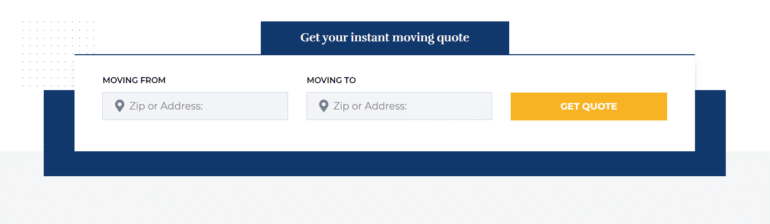
Start with the sizes that fit most placements: Medium Rectangle (300×250), Leaderboard (728×90), Large Rectangle (336×280) and Half Page (300×600). For your own site, a wide mid-page banner with a CTA to get a moving estimate is a simple, reliable pattern.
Build a clear visual hierarchy
Give the eye one path: headline first, visual second, button last. Use a modest border in your brand colors to separate the banner from a white page, and skip decorative frames. Pick colors that match your brand and keep enough contrast for the text to stay readable at small sizes.
Write banner copy that earns each character
Banner text is tight, so every word must work. Keep the tone transparent and concise, with one message and a limited number of characters. If you animate the banner, keep it under 10 seconds and still show the CTA in the final frame.
Make the call to action obvious
For movers the CTA usually revolves around getting a quote or estimate. Use a button, not a text link, and name the outcome: “Get My Estimate” beats “Click Here.” More wording options are in this guide to effective CTAs for booking moving jobs.
Keep the file light and the landing page consistent
Use JPG, PNG, GIF or HTML5, never Flash, and keep the file under 200 KB so pages load fast. Then make sure each banner clicks through to a page that repeats its offer, and track click rate by banner so you know which size and position earn their place.
How do you test and improve your moving ads?
Treat every campaign as a test with one goal: booked estimates, not clicks. Change one thing at a time, such as the headline angle, the CTA or the proof line, and compare results over enough time to see a pattern. Review ads on a schedule and update them when performance, season or landing page changes. Wording tweaks cost nothing and often move results without raising budget.
Platform automation now picks audiences and combinations for you, which makes clean inputs more important. For how that changes your setup, see how AI targeting on Google and Facebook helps moving companies and new Google Ads features.

What to fix before your next moving ad goes live
A high-converting moving company ad respects how people think when they need a mover. It focuses on clarity, reduces uncertainty and makes a promise the rest of the experience can keep. When ads copy competitors or try to explain too much, they lose impact before the click. At Movers Development, we build and manage moving company ads for 400+ moving companies across the US, Canada, and other countries. Request a free marketing analysis and we will review your current ads, or contact us to talk through your next campaign.
Frequently Asked Questions
What makes a moving company ad high-converting?
A high-converting moving company ad reflects the buyer's mindset, makes one clear promise, reduces uncertainty and matches the message on the landing page. Buyers are under time pressure and worried about fees and damage, so clarity and relevance beat clever slogans. If the ad promises a written estimate, the landing page should lead with the estimate form, so the click feels like a natural next step.
How long should a moving ad be?
As short as possible while still making one clear promise. For Google Search, responsive search ads allow headlines of up to 30 characters and descriptions of up to 90 characters. Display banners should carry one message and one button, and a YouTube bumper runs six seconds. In every format, one scannable idea works better than a list of services.
How often should moving ads be updated?
Review them on a schedule based on performance data, and update them when results drop, the season changes or your landing page changes. Change one element at a time, such as the headline angle, the CTA or the proof line, so you know what caused the difference. Small wording changes often improve results without raising your budget.
What is the best way to advertise a moving business?
Most moving companies start with Google Search ads and Local Services Ads because they reach people who are actively looking for a mover. Add Meta ads and display or retargeting banners once your landing page converts. The best mix depends on your market and budget, but every channel needs one clear promise and a landing page that matches it.
Is TV advertising worth it for moving companies?
For most local movers, TV is not the best starting point. It reaches a broad audience, much of it not planning a move, and costs more than digital options that target people searching for movers. Pay per click and social ads can be aimed at specific cities and move types, so they usually suit moving company budgets better.
What banner ad sizes work best for moving companies?
Four standard sizes cover most placements: Medium Rectangle (300x250), Leaderboard (728x90), Large Rectangle (336x280) and Half Page (300x600). Whatever the size, keep one headline, one visual and one CTA button, such as Get My Estimate, and keep the file under 200 KB so it loads fast and does not slow your page.
How many headlines and descriptions can a responsive search ad have?
According to Google Ads Help, a responsive search ad can have up to 15 headlines and 4 descriptions. You must enter at least 3 headlines and 2 descriptions. Headlines can be up to 30 characters and descriptions up to 90. Google tests combinations of your assets, so give each headline a different job instead of repeating one claim.
Should movers pin headlines in responsive search ads?
Pin only when you must, such as a disclaimer that has to appear in every ad. Google notes that pinning reduces the combinations it can test and is not recommended for most advertisers. A hybrid approach works better: pin one or two essential keyword headlines, like your city and service, and let proof and call-to-action headlines rotate.


